
Cape Winelands
The Cape Winelands, in South Africa, is famous for its beautiful vineyards and exquisite wines.
Overview
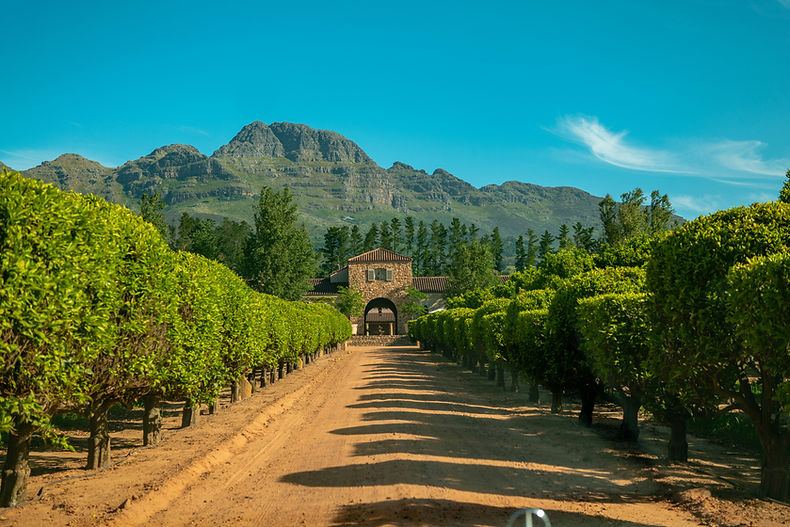
An hour from Cape Town, the landscape changes entirely. The highway narrows into wine routes. Mountains appear in every direction. And between them, the valleys of Franschhoek, Stellenbosch, and Paarl unfold into some of the most beautiful wine country on earth — Cape Dutch homesteads gleaming white against granite slopes, old oak trees arching over cobbled streets, and estate restaurants where long lunches become an art form.
The Cape Winelands are not a detour from a South Africa itinerary. For those who love food, wine, and unhurried beauty, they are the reason to come.
What To Expect
The Winelands region is centred on two towns with very distinct personalities, both worth time of their own.
Franschhoek — French Corner — was settled by Huguenot refugees in the late 17th century, and the French influence is still present in its estate names, its cooking, and its particular obsession with doing lunch properly. The valley is narrow and extraordinarily beautiful, with vineyards climbing the lower slopes of the mountains and a single main street lined with some of the best restaurants in South Africa.
Stellenbosch is the heart of the Cape wine industry — home to South Africa's leading wine university and over 150 estates within easy reach of the town centre. It is older, larger, and more architecturally varied than Franschhoek, with a beautiful historic town centre of white-washed Cape Dutch buildings, wide avenues of ancient oak trees, and a lively food and gallery culture.
Beyond these two anchors, the Winelands reward exploration. The Hemel-en-Aarde valley south of Hermanus produces some of South Africa's finest cool-climate Pinot Noir and Chardonnay. The Swartland, to the north, is where the most exciting new-wave South African winemakers are working — natural, low-intervention wines from old bush vine chenin blanc that are attracting serious attention internationally.
For birders, the Winelands are worth exploring more seriously than most itineraries allow. The fynbos estates around Stellenbosch and the wetlands near Paarl hold good populations of Cape sugarbird, orange-breasted sunbird, and several endemic species found nowhere else on earth.


When to Visit
The Winelands are beautiful year-round, but each season has a different character.
Summer (November through April) brings harvest season from late January — watching the vineyards stripped of their fruit, tasting from the barrel, and being in the valley when everything smells of fermenting grapes is a genuine privilege. Summer days are long, warm, and reliably clear, and the outdoor restaurant seating comes into its own.
Autumn (March to May) is arguably the most beautiful time — the vine leaves turn gold and amber against the mountain backdrops, temperatures are perfect, and the post-harvest quiet means more personal attention at the estates.
Winter (June to August) is low season, with cooler, sometimes rainy days, but also the lowest lodge rates, intimate cellar experiences with few other visitors, and the particular pleasure of an open fire and a good Cabernet at the end of the day.
The Winelands combine naturally with Cape Town — most estates are 45 minutes to an hour from the city — and work beautifully as a one- or two-night extension, either before a safari or as a way to decompress after one.
FAQs: Frequently Asked Questions
Franschhoek or Stellenbosch — which should I choose?
For first-time visitors who want the most concentrated wine and food experience, Franschhoek is the easier choice — the valley is compact, the quality is consistently exceptional, and the setting is uniquely beautiful. Stellenbosch rewards those with more time — it has greater variety, a more authentic local atmosphere, and a wider range of estate styles. Ideally, spend a night in each: they are 30 minutes apart and entirely complementary.
How many days should I spend in the Winelands?
Two nights gives you a genuine feel for the region — enough time for two or three estate visits, a long lunch, an evening exploring the town, and a morning drive through the valley before moving on. Three nights is better if you want to cover both Franschhoek and Stellenbosch, or add a day in the Hemel-en-Aarde valley near Hermanus.
Do I need to book wine tastings in advance?
For the large, well-known estates, walk-in tastings are usually available but a booking is always advisable in peak season (December through February and over Easter). For smaller boutique producers and restaurant-style tasting experiences, advance booking is essential — particularly for lunch at the top estate restaurants, which can fill up weeks ahead.
Can the Winelands be combined with a safari?
Absolutely — and the contrast is part of what makes a South Africa journey so compelling. The most seamless combination is one to two nights in the Winelands as part of a Cape Town extension, followed by a flight from Cape Town to Hoedspruit or Skukuza for a Greater Kruger safari. Some clients also combine the Winelands with the Garden Route as a road trip south before flying north to the bush — a wonderful week-long itinerary that covers every register of what South Africa offers.